
A Short History of Nearly Everything
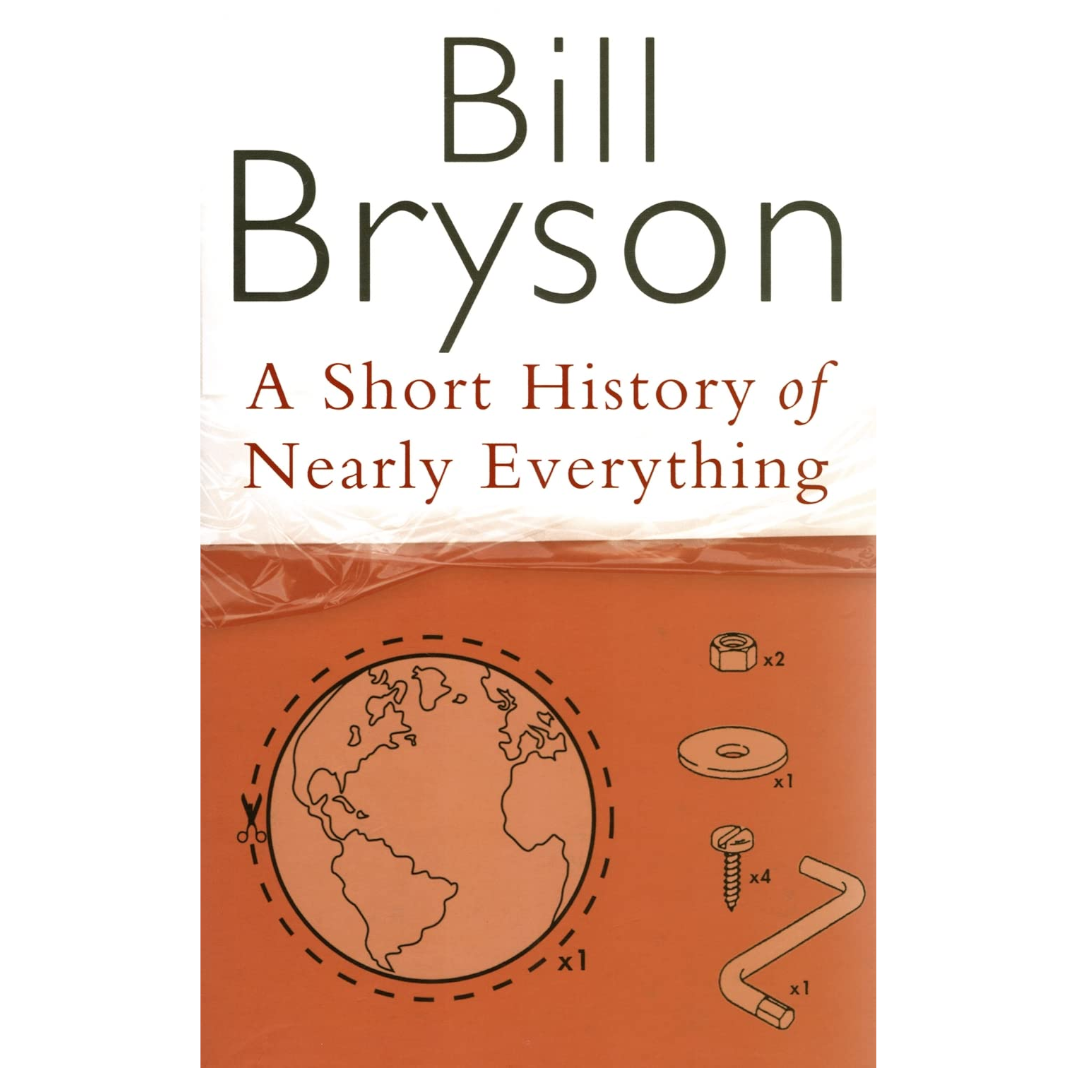
A Short History of Nearly Everything by Bill Bryson is a popular science book that seeks to explain, in clear and often humorous prose, how the universe and everything in it came to be understood. Published in 2003, the book represents Bryson’s attempt to make sense of scientific ideas that he felt most people never had properly explained at school. His approach combines curiosity, storytelling, and a genuine admiration for the scientists who pushed human knowledge forward, sometimes against extraordinary odds.
Bryson begins by exploring the origins of the universe, describing the Big Bang and the astonishing improbability of our planet forming as it did. He moves on to chart the development of scientific thought, from early astronomers who risked punishment for challenging accepted beliefs to modern researchers using advanced technology to look deep into space or examine the tiniest particles of matter. Throughout these sections, Bryson highlights not only major discoveries but also the personalities behind them—eccentric, determined, sometimes overlooked individuals who shaped our understanding of the world.
The book also delves into Earth’s formation, geology, and the astonishingly fragile conditions that make life possible. Bryson explains natural phenomena such as earthquakes, volcanoes, and the shifting of tectonic plates, showing how much of our planet’s history is violent and unpredictable. His chapters on life sciences cover the emergence of early organisms, evolution, and the remarkable diversity of species, all presented in a way that is accessible to readers without a scientific background.
What makes the book especially engaging is Bryson’s ability to convey both the scale of scientific knowledge and its many gaps. He reminds readers that much about the universe remains mysterious, and that some breakthroughs happened almost by accident. In doing so, he celebrates human curiosity and the continuous quest to understand the world.
5 Key Takeaways
Curiosity drives scientific discovery more than certainty.
Bryson shows that many breakthroughs began with simple, persistent questions rather than grand theories. Scientists often stumbled upon insights by following their curiosity or investigating odd results. This highlights the importance of remaining open-minded and willing to explore the unknown.
The conditions that allow life to exist are incredibly delicate and improbable.
From the precise balance of cosmic forces during the Big Bang to Earth’s distance from the Sun and its protective atmosphere, a series of unlikely events made life possible. Understanding this fosters a deeper appreciation of both the planet and our place within the universe.
Despite centuries of research, humanity still understands only a fraction of the cosmos.
Bryson repeatedly emphasises that vast areas of scientific knowledge remain uncertain or incomplete. Whether it is the origins of life, the behaviour of subatomic particles, or the structure of the deep oceans, much remains mysterious. The book encourages readers to see science as an ongoing conversation rather than a finished body of facts.
Scientific progress is often achieved by determined individuals working against the odds.
Many scientists featured in the book faced financial hardship, social scepticism, or academic isolation. Yet their dedication laid the foundations for modern understanding. Their stories remind us that perseverance, creativity, and the willingness to challenge accepted ideas are essential for innovation.
Earth’s history is shaped by powerful natural processes that continue today.
Bryson’s exploration of geology, climate, and evolution reveals how dynamic the planet truly is. Tectonic shifts, volcanic eruptions, and mass extinctions have shaped life repeatedly. Recognising these forces helps us appreciate both the planet’s resilience and the need to care for our environment as it continues to change.